
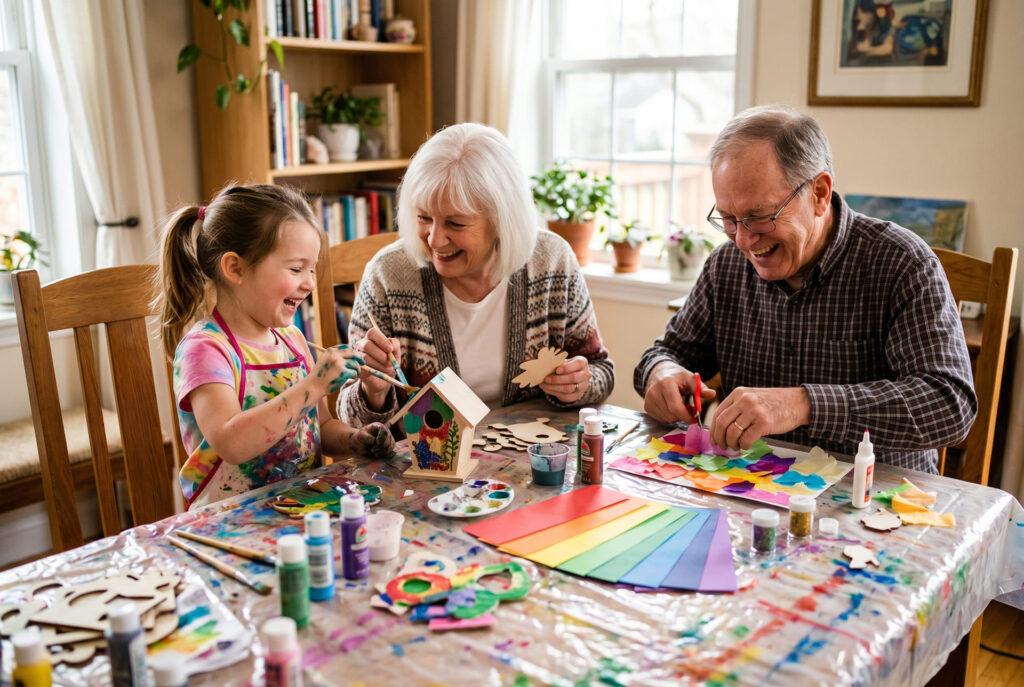
For grandparents who are active caregivers, and for adult children supporting aging parents, playtime can bring real joy and meaningful intergenerational bonding. The hard part is that what used to feel effortless can now come with worries about child safety at home, balance and stamina, and the risk of bumps, spills, or overexertion. Add in dementia concerns or changing mobility, and even simple games can feel stressful for senior caregivers and playtime. With the right mindset, safe grandchild activities can build confidence and keep connection at the center.
Choose 7 Kid-Approved Activities (With Easy Safety Tweaks)
When playtime feels safe and doable, grandparents can relax, and kids can actually stay engaged. Use this menu to match the day’s energy level, the child’s age, and the home setup you have.
- Try a “two-minute science” experiment at the table: Keep child-friendly science experiments short and contained, think baking soda + vinegar in a tray, or “sink or float” with a bowl of water and a few safe household items. Seat everyone, lay down a towel, and use unbreakable cups to cut down on spills and bending. For toddlers, pre-measure ingredients; for older kids, let them predict what will happen and write one sentence about the result.
- Do simple garden jobs with clear boundaries: Garden activities for kids can be as small as filling one pot with soil, watering with a small cup, or hunting for “three new leaves.” A program description like seed, sow, water, harvest works as an easy checklist, so choose just one step per visit to avoid overexertion. Safety tweaks: use kneeling pads or a chair, kid-sized tools with blunt edges, and set a “no pesticides today” rule when little hands are helping.
- Pick low-mess crafts with a “contained kit” rule: Arts and crafts projects go smoother when everything stays in one tray or bin: pre-cut shapes, washable markers, glue sticks, and stickers. To protect joints and reduce reaching, tape paper to the table and use larger crayons or foam brushes that are easier to grip. For mixed ages, give younger kids stickers and tearing tasks while older kids handle cutting with safety scissors.
- Share a hobby in “micro-steps” rather than lessons: Shared hobbies for seniors and kids feel successful when the goal is participation, not performance, sorting coins, matching socks, looking at family photos, or doing a simple puzzle together. Set a 10–15 minute timer and stop while it’s still fun, especially if a grandparent tires easily. If frustration pops up, switch roles: the child becomes the “helper” who fetches pieces or turns pages.
- Cook one snack or mini-meal with pre-set stations: Cooking with grandchildren is safer when tasks are separated: one station for washing, one for mixing, one for assembling. Choose no-knife recipes and use a stool for kids rather than having them climb on chairs; for grandparents, keep everything at counter height to avoid lifting and carrying. A list of Quick and Easy Meal Ideas can help you pick something simple like “assemble-your-own” parfaits or jar salads.
- Take a “two-loop” nature walk with an exit plan: Nature walks for families don’t have to be long to be meaningful, try one short loop near home, then offer a second loop only if everyone still feels good. Bring water, a phone, and a small “treasure bag” for leaves or smooth rocks; make the rule that grown-ups don’t carry kids, to prevent falls and strain. If balance is a concern, choose flat paths and schedule walks at cooler times of day.
- Make reading time interactive and seated: Reading sessions for children work especially well on low-energy days: sit side-by-side, use good lighting, and keep a pillow under the reading arm to reduce fatigue. Ask simple prompts, “Find something red,” “How do you think they feel?”, so kids stay engaged without anyone needing to move around. If attention is short, read one story, then let the child “tell” a picture story while the grandparent listens.
When you keep activities short, seated when possible, and easy to pause, playtime stays fun without pushing anyone past their limits, and it’s always good to have a calm, indoor creativity option ready for days when mess or mobility is a concern.
Co-Create Cartoons and Mini-Stories for Calm Indoor Creativity
When paint, glue, or outdoor time feels like more effort than fun, you can still keep creativity going from a comfortable seat. Encourage your grandchild to use a cartoon generator to dream up silly characters or mini-stories together, an easy, screen-based break that can still spark imagination and help everyone unwind. Adobe Firefly’s AI cartoon generator is a creative tool that quickly turns simple text prompts or photos into custom cartoon-style images and short animated clips, so kids get that “I made it!” feeling without a big mess.
For example, you might take turns describing a superhero pet, a friendly robot, or a “day at the zoo” story and see what the cartoons look like. Before you start on any activity, the next section’s one-page checklist helps you set up a quick safety scan so play stays relaxed for everyone.
Five-Minute Safe-Play Setup Checklist
A quick scan helps you protect your parent’s energy and your child’s curiosity, without turning fun into worry. A home safety checklist also gives adult children a simple way to confirm the space works for safe, confident caregiving.
✔ Clear floors and pathways for steady walking and quick responses
✔ Set one play zone with good lighting and stable seating
✔ Move cords, small parts, and hot drinks out of reach
✔ Confirm device volume, brightness, and time limit before starting screens
✔ Review bathroom access and keep a nightlight on if needed
✔ Agree on supervision roles and a “stop” word for rough play
✔ Plan two short rest breaks and keep water within reach
Small prep now makes room for bigger smiles later.
Playtime With Grandkids: Questions Families Ask
Q: What play activities work best when my parents have limited mobility or stamina?
A: Choose “sit-and-stay” options like puzzles, sticker books, read-alouds, simple crafts, or gentle ball rolling. Keep supplies in a small bin so nothing requires repeated trips across the room. Aim for short rounds and end on a success, not when someone is wiped out.
Q: How can grandparents handle high-energy play without getting hurt or overwhelmed?
A: Set clear “active minutes” and “calm minutes,” then rotate between them. Pick games that keep kids moving while the adult stays steady, like scavenger hunts with a seated “clue giver.” If breathing gets heavy or balance feels off, pause immediately for water and a reset.
Q: When should we adjust activities based on my child’s age and safety needs?
A: Adjust anytime there’s mouthing, climbing, or impulsive grabbing, especially with toddlers and preschoolers. Swap tiny pieces for larger items, avoid lift-and-carry games, and keep playing at floor level. When in doubt, simplify the rules and slow the pace.
Q: How do we set screen-time boundaries that won’t cause a fight?
A: Decide the time limit before the device comes out and use a timer everyone can hear. Since children under 2, media use per day can add up quickly, plan one short, shared show and then switch to a hands-on activity. Keep screens out of the last hour before bed if sleep is already tricky.
Q: What simple safety rules should we agree on before visits?
A: Use three basics: no roughhousing near furniture, no running indoors, and one adult stays “in charge” while the other takes breaks. Teach kids a clear stop word and practice it once at the start. If anyone feels unsteady, the rule is to sit first, then decide what to do next.
Simple, Safe Play That Builds Lasting Grandparent Connections
Balancing fun with safety can feel tricky when energy levels, mobility, and screen-time expectations don’t always match up. A calm, flexible mindset, keeping play predictable, age-appropriate, and paced, helps families focus on safe family interactions without losing the laughter. When those guardrails are in place, meaningful grandparent moments come more easily, and senior caregivers can relax into the simple joy in caregiving while valuing quality time with grandkids. Safe, simple play is how close bonds grow. Next time, you can choose one activity and one safety habit to keep the moment steady and enjoyable. That steady closeness supports confidence, connection, and well-being for everyone over time.